Diaries of the Breadman’s Daughter: There’s Nothing Like the Smell of Coffee in the Morning.

Ma and boo in PJs enjoying a morning moment.

I’m a morning person. I get up early while my family remains nestled all snug in their warm comfy beds. This does not mean they are sleepyheads.  Or lazybones.  It’s just that I’m a particularly early riser.  For it is only at this time that the house is quiet and still.  Like the Herman’s Hermits song proclaims, “there’s a kind of hush.”  Just the way I like it.

When I’m in full-blown writing mode I get up, I make a cup of hot tea and head for my room.  But it wasn’t always so.  The room was there but I wasn’t.  I was in another room with a bed and a warm body next to mine.  That was, and is, nice.  But for a writer, and a creative spirit, it’s not enough.  I made excuses for why I wasn’t in my very special room doing creative things.  You know the kind. Family commitments.  Full time job.  Busy life full of distractions and diversions.  Pets to walk. Cakes to bake.  But excuses aside, the truth was it made me sad.  Glum.  Blah.  Whiny even.  Then I had this eureka moment about 15 years ago. The switch was flipped and the light went on. I had this notion that if I got up an hour or two earlier I could go into my room and do stuff.  At the time, I wasn’t sure what that would be exactly.  But as it turns out I had a novel to write.  Some poems. A ton more letters to God.  And a few song lyrics. Then some music to go with those.  I learned that much can be accomplished in the wee hours before 6:00am.

The truth is, it wasn’t all that difficult for me to get up that early in the morning.  Pre-dawn rising is part of my family heritage.  If geneticists were to look inside our DNA, I’m certain they would find some little atypical first-light wrinkle in one of our chromosomes.

Little back story.  Because the Old Man was a Breadman, his workday began early.  Crack of dawn.  He had to get to the bakery, load his truck and be on the road delivering the bread and other baked goodies by 7:00am.  This was back in the day, when it was essential to deliver the ultimate in freshness door to door.  Warm and ready.

Ma always got up with The Old Man.  While he was getting ready for work, she was busy in the kitchen.  A fresh pot of coffee was perking in the dinted aluminum Percolator with the black handle and glass knob on top.  Once the water-coffee mixture began to bubble up into the knob, Ma would turn down the heat and let it settle and simmer on low.  While the coffee was brewing, the well-oiled cast iron frying pan was in full-on action.  Four strips of bacon fried to a medium crisp.  Two eggs.  Sunny side up with a fringe of brown crunch.  Two slices of white Wholesome bread toasted to golden perfection, then buttered.  The table was set for one.  Next to The Old Man’s plate was a jar of Kraft strawberry jam or orange marmalade, a bottle of homogenized milk, a bowl of white sugar, and glass shakers of salt and pepper.  These were the scrumptious aromas of morning for the thirty-plus years that The Old Man worked for the bakery.  This was the first heavenly scent of dawn and waking up.

Sometimes I would get up before The Old Man left for work and join him at the table.  But mostly I got up afterwards and had breakfast alone with Ma.  I loved my morning time with her.  I was never really that hungry in the morning but I ate anyway.  Mostly to appease Ma, so she wouldn’t worry or fret that I was malnourished or starving to death.  Ever since I was a youngster I drank coffee.  The Old Man was a Finlander so coffee was a huge part of his personal culture.  Next to Vodka, coffee was the Finn’s beverage of choice.  The coffee of my wonder years was nothing like it is today.  We’re not talking Starbucks super strength here.  Back then, coffee was akin to dish water.  And we were blissfully ignorant of any harm it may have caused a child.  I enjoyed my daily morning coffee until I hit my early twenties when I quit cold turkey.  As it turned out, it wasn’t so good for my sensitive nervous system, causing my body to shake rattle and roll after one or two sips. Tea, in particular herbal or decaf, then became my beverage of choice for decades.  It’s only been recently that I have started to enjoy one cup of coffee in the morning.  All things wonderful.  Ma and I were also Tea Grannies and loved our Orange Pekoe and Earl Grey.  Especially with fresh-baked cookies.  Simply divine.

For the most part, Ma and I had toast and jam for breakfast. We kept it sweet and simple.  White bread.  Lots of butter slathered on first, then a big dollop of jam.  Sometimes we’d add peanut butter.  Sometimes we didn’t add anything.  Just butter.  It all depended on whether we were in a sweet or savory mood.  My morning coffee was really more milk and sugar than it was coffee.  And it was delicious.  Sweet.  And creamy.  I drank it down quickly in big gulps.  Sometimes I slurped it from my spoon like soup.  But mostly I poured it back. “Ahhhhh.  That was sooooo good Ma,” I’d exclaim.

I enjoyed this quiet breakfast time with Ma.  We drew together, both in our flannel nighties, and talked about things.  The kinds of conversations mothers have with their little girls.  Precious.  Intimate.  Confidential.  I shared all my secrets with her.  I knew she was the one person in the entire world that I could trust completely with my tender young heart. I told her funny stories.  She laughed.  I relayed the nightmare that woke me up in the middle of the night.  She comforted.  I confessed my unrequited love.  She consoled.  I cried over my broken heart.  She caressed.  I confided my dreams for the future.  She encouraged.   I hurt her feelings.  She forgave.

On special occasions or holidays, when the family gathers, I still like to get up early, even though I don’t write during vacation time.  Our entire family comes together at Christmas and I’m usually the first one up.  I like to putter around in the kitchen and put the coffee on.  And that’s when it happens.  The fresh brewed aroma takes me back.  To a little kitchen table with its cheerful homespun tablecloth.  It’s set for two.  It’s cold and dark and wintry outside.  But it’s warm and bright and safe inside.  Ma pours me a cup.  Life is good.
Diaries of the Breadman’s Daughter: Insomnia and the Power of One.

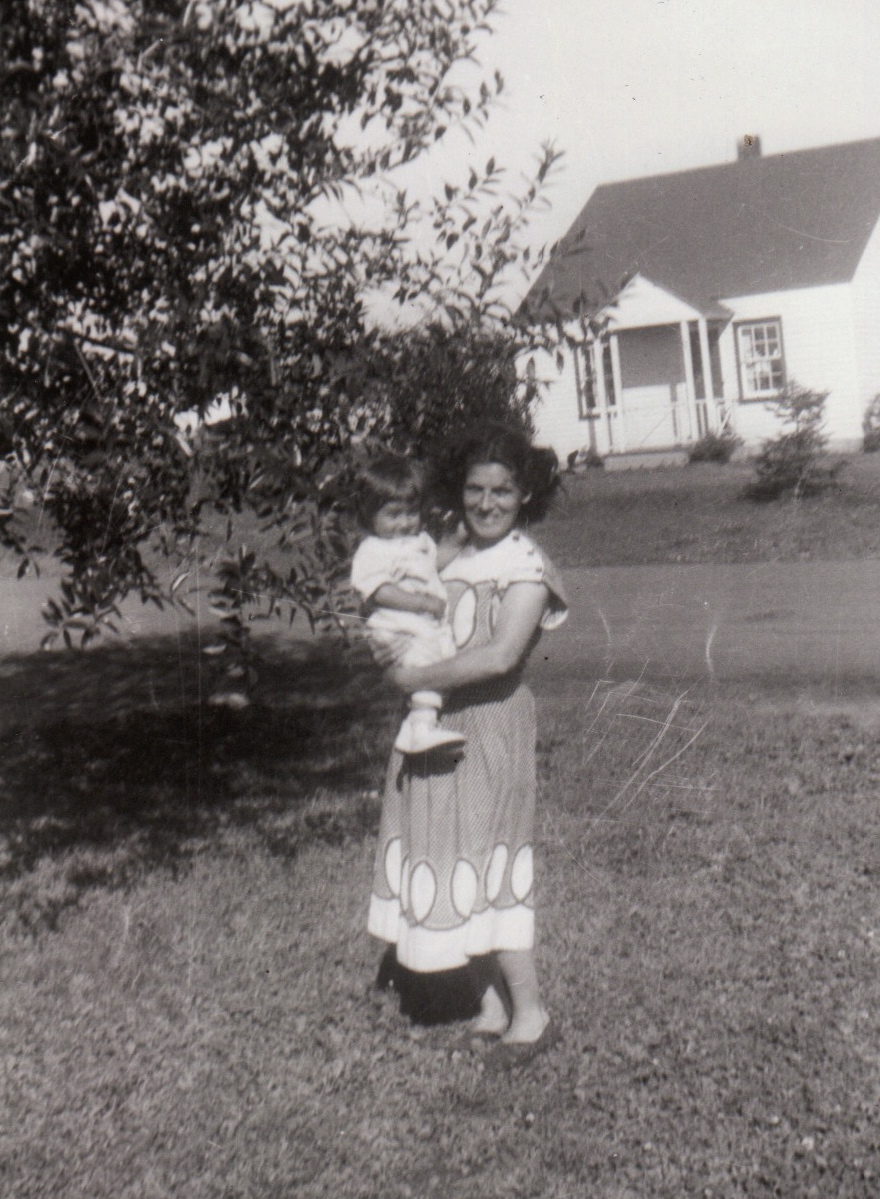
Ma loved all children but especially me.

I like to give.  I also like to receive.  But giving just feels so much better.  You get that warm and fuzzy feeling.  All gooey inside like a hot fudge sundae.  And there’s this glow that appears all around your edges.  Like the kind Angels wear and Beyonce sings about.  You know what I’m talking about. The halo. There’s also music.  Harps and lutes and chirpy birds.  It’s marvelous.  All this just from the simple act of giving.

Ma was a bigger giver.  And The Old Man would give you the shirt off his back without hesitation.  But I learned all about giving to people I didn’t know, and who lived in worlds far beyond our borders, from Ma.

Little back story.  Many years ago, when I was a much younger version of myself, I was living with my two oldest kids in the Italian neighborhood of Toronto.  It was a bleak period in my life.  I was separated, raising two kids alone, had a low-paying job, not much of a social life, lonely, frightened and lacking in resources.  I was also an insomniac.  Still am.  I spent endless nights ruminating over the state of my life.  Looking under every imaginary rock to see what was lurking there.  Leaving no stone unturned.  It was torture.  Self-inflicted torment.  Oh the wretched scourge of it all. Woe was me.

Much of my time was spent worrying about money.  There was never enough.  I took the expression “robbing Peter to pay Paul” to all new heights.  Gave it fresh and new meaning. I was equally inventive and creative with my money management.  Plus, I was a master juggler of serious magnitude.  My financial situation was in such delicate balance that I was a one-woman circus act.  It would have been hilarious had it not been so pitiful.  Or my life.

It was during one of these sleepless nights that I learned one of the most profound lessons on giving.  Typically when I have insomnia I stay rooted to my bed like a beached whale on a California shore.  I toss.  I turn.  I thrash.  I flip pillows.  Pound them.  Beat them to a pulp.  Then ultimately toss them on the floor.  I kick my legs in and out of the covers.  I roll my eyes inside my head until they hurt.  I try to substitute my dark morbid thoughts for pleasant ones that involve sunshine and fields of daisies.  Eventually I succumb.  I never really know when or why.  But eventually the Sandman pays me a visit and I slip fitfully into Dreamland. Or Nightmaresville.
But on this particular night long ago, something mystifying compelled me to get out of my bed and walk down two flights of stairs to our basement rumpus room.  It had a television and was far enough away from my sleeping children not to disturb their peaceful and tranquil slumber.  Oh how I envied them.

It was the hour of the wolf and I was fully expecting to see nothing but snow and static on the television.  That suited me just fine.  My head was spinning and my heart was howling with fear and bitterness.  I was in no mood to be touched by anything broadcast in those murky unsettling hours before dawn.  But I was.  Deeply.  So powerfully in fact, that what I saw would stay with me for the rest of my life.

I guess it was an infomercial.  Although that seems far too trivial a description for what this was.  There were no hawkers of magic mops and make-up.  Nothing of that nature was going on.  But it sold me none the less.  It grabbed a hold of my heart and hasn’t let go since.

In the quiet of that early morning gloom I stared into the faces of sweet innocent children thousands of miles away who had nothing.  And I was broken. And humbled.  Saddened beyond description.  I saw bellies swollen from hunger and thin tiny limbs covered in sores.  Poverty.  Sickness.  Strife.  Yet in the eyes of these beautiful ones I also saw my own two children.  No different.  They were children. Kids.  Just like mine.  Suddenly my first world problems were put into perspective.  So I did what I often do in situations like this.  I had a little chat with God.

It went something like this.  “Okay, here’s the deal.  I’m on my own and I’ve got these two kids and three cats to take care of.  I can barely make ends meet.  Just ask Peter and Paul.  But I can’t deny what I just bore witness to.  I need a few extra bucks every month to help one of these kids and their families.  That’s all.  A few extra bucks.  Plus I need your help with my own kids too.”

That was the promise made.  That has been the promise kept.  On both our counts.

I also thought of Ma that night.  And wondered if she had ever made the same deal.  She had four kids and an alcoholic husband, who often in their early years together, spent his paycheck before it was earned. She was like the woman in the Bible who had little but gave much.  Ma’s five or ten dollars sent off to this charity or given to that cause was like the millions given by the wealthy.  She too supported a third world child.  I remember the photographs she received of her foster children over the years.  She never boasted.  She just quietly and faithfully gave every month for years.  They could count on her.  She loved children so.  No matter where they came from.  She wanted to help. To do something to change the course of even one child’s life.  Ma was a shining example of the power of one.

Flash forward.  It’s years later and I’m living on the Westcoast. It’s the middle of the night.  I can’t sleep.  But I can’t stay in bed either.  I have a room of my own now with a computer where I dream and make magical things happen.  Life is different.  I no longer ride it out.  Instead I write it out.  It’s raining as it so often does out here.  I’m worried.  There are wars.  And rumors of wars.  People are suffering.  Everywhere.  My heart aches and my head can’t make sense of any of it.  I get up.  I go to my computer and I write this poem.

A Mother’s Prayer for Peace

Dear God,

It’s the middle of the night,
And I cannot sleep.
The rain is pounding on the roof
And the wind is howling outside my window.
But I am safe and warm,
Comforted by my feather duvet.
My faithful dog curled up at my feet
And my husband breathing softly next to me
Our children safe in their beds
Surrendered to dreams,
Sweet sweet dreams.

Yet my heart is not at peace,
It is broken with sadness.
For out there
Somewhere in a world I do not know
In countries I’ve only seen on TV
Are other families
With mothers just like me,
Who but for your gentle grace
Live a different life.
One not privileged with
Warm safe beds to rest,
To sleep, to dream of tomorrow.

Their lives, every bit as precious as mine
Are torn apart and shattered –
By fear
And hate
And hunger
And disease
And disaster
And ignorance

WAR.

I pray for these loving mothers
And for their dear families
That they ALL
Each and every one
Have what I have
And know, truly know
What it’s like
To go to bed at night
And NOT be filled with fear
That their beautiful child,
Every bit as precious as mine,
Won’t be harmed
Or blown to piece
By the enemy lurking at the door.

God, I pray that all these mothers
Know at least one moment of peace.
And that that moment grows and grows
Like a wave across the world.

A graceful, gentle, loving wave of peace.

It begins with one moment
And grows from moment to moment.
It begins with one mother
And grows from mother to mother.
And it saves one child
And grows from child to child.

May we share this moment of peace
Mothers of the world.

Now I lay me down to sleep.

Amen.

In gratitude and love,
boo king

Diaries of the Breadman’s Daughter: Hold Me Closer Tiny Dancer.

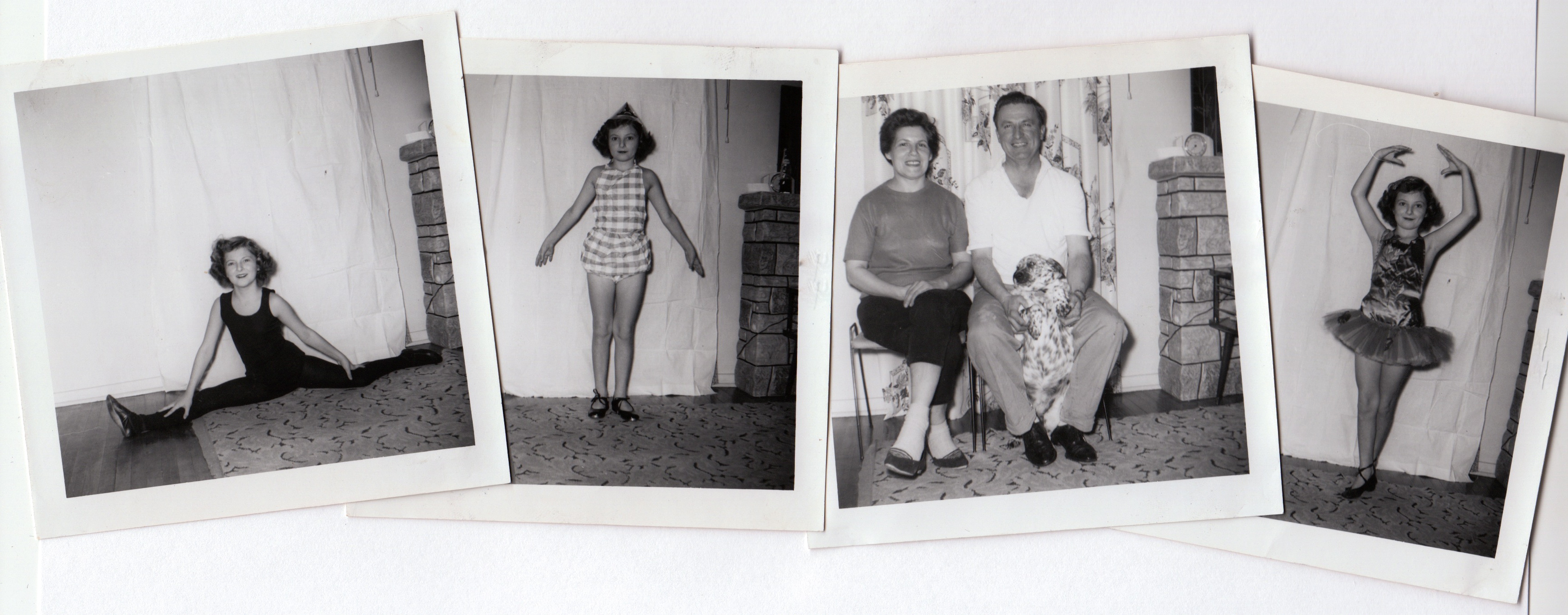
After the photo shoot. Ma, The Old Man and Sugar.

I like to dance.  I’m lousy at it but that’s beside the point.  I have two left feet apparently.  I lack rhythm.  Poise.  And most importantly, grace.  I’m a klutz.  I bang into door frames and stumble farcically over cracks in the sidewalk.  But I flat-out refuse to accept the mountain of corroborating evidence that even though I’m a lousy dancer, I should pack it in altogether.  That’s just not going to happen. I may be in denial but I like it.  Nothing can stop me from shaking my booty.  Strutting my stuff.  Tripping the light fantastic.  And shuffling off to Buffalo.  My personal history has taught me that it may not be such a great idea to dance in public. But in the privacy of my own room, I can boogie on down and dance dance dance.

Little back story.  When I was six or seven I started taking ballet, tap and acrobatic lessons from Mrs. M.  Although I took lessons for seven years I never really got very far.  The writing was on the wall, “This girl needs to take up another activity. Like bowling. Or Paper Mache.”   Ma and The Old Man didn’t see it that way though. Just as I am in denial today, they were equally blind back then to the abysmally obvious. They had no perspective when it came to my talent.  Or lack thereof.  I was their child.  Everything I did delighted them.  As it should be.  But the truth is, I knew, and Mrs. M. knew, that I was never going to be the next Anna Pavlova.

My memories of Mrs. M. are vague and sketchy at best.  Blurry little reveries of wooden floors and pointy toes fused with young girlie scents and self-conscious glances.  Unlike Terpsichore, Mrs. M. did not find me amusing.  No, I was not her muse.  And unlike Ma and The Old Man, she did not take delight in my dance.  But she was my teacher for seven years and I do give her top marks for perseverance and tolerance.  And for not telling my parents to take my ballet shoes and go home.   I was also irrationally terrified of her.  In my mind she was at least 75 years old and monstrous.  Realistically she was probably only 45, but when you’re seven and small, anything over thirty is ancient and intimidating.

I wanted nothing more than to have made my inept body perform better.  But it just wouldn’t.  In addition to lacking rhythm, poise and grace, I lacked flexibility.  Especially in my legs and lower back.  Having pliable stretchy elastic Gumby body parts in these two areas is  undoubtedly advantageous.  This particularly comes in handy when performing moves like “the splits.”  I don’t advise that any human over the age of thirty attempt doing these. At least not without an Emergency Medical Team on hand to revive you and uncork your legs.  Even the sound of the word hurts.  Splits.  OUCH.

I remember practicing. Diligently. Tenaciously.  Willing my legs to  flatten.  Forcing them downwards towards the floor.  Long before I knew what visualization was, I would lie in bed and see my skinny bowed legs getting closer and closer to the floor.  It was painful.  Eventually I got pretty close. If I scootched my bum just right, sort of off-kilter and leaning towards one side, it sorta-kinda looked like I was doing “it.”  And that pretty much summed up everything about my dance career.  I got close, and as Groucho Marx or W.C. Fields put it, “but no cigar.”

In what would be my final year of lessons, I got to participate in the annual dance recital.  The Dance Revue.  Two horrifying nights of performances on a Friday and Saturday, in June. I still have the blue and green program from the evening.  My last name was spelled wrong throughout.  In the program it proclaims that in the first half of the evening I performed in three of the “Varieties” called Recital Time, Destination Moon and Tumblers. After the Intermission, that lasted precisely 3 minutes according to the program, I also performed in a dance called Flowers Awaken in the “In A Flower Garden” feature. It goes without saying, I was a supporting player, not a soloist like Donna M or Bernice H or Barbara C or Wendy W.  I probably secretly hated all of those girls.  A Prima, I was not. I didn’t even make it into the Grand Finale “Around The World” feature, of which there were sixteen.  You think she could have at least thrown me into the back row of Chantez Chantez or Canada The Hop Scotch Polka.  Everyone seemed to be in those little numbers.  Except me.

Ma made all of my costumes. Lovingly. Tenderly. Ardently.  I thought they were divine. Worthy of a Princess.  A Prima Ballerina.  I still have those too.  They’re wrapped in tissue and stored in a McNulty’s box in my storage closet.  I can still feel my mother’s touch on the fabric. And it breaks my heart.

Recital Time was a snappy little tap ditty.  The fabric for this costume looked like it once adorned Ma’s kitchen table.  A hot pink checkered gingham number with puffy little pants and a bib-like top tied in a bow at the nape of my neck.  The piece de resistance was the pointy little hat, that closely resembled a New Year’s Eve Party Favor or a small dunce cap. I think I wore the same costume for Destination Moon because the hat could also work as the nose cone of a rocket.  For Tumblers I wore a simple black leotard with tights and black ballet slippers.  My leotard was the wrong kind.  All the other Tumblers had leotards with short sleeves. I was self-conscious and embarrassed by the lack of sleeves on mine.  I never told Ma she bought the wrong kind but it was plain to see I had four inches of uncovered flesh on my upper arms.  In Flowers Awaken I wore an orangey rust colored tutu made of satin and crinoline with fake silk flowers strategically attached to my torso.  But thankfully there were no hats.

Ma and The Old Man thought I was marvelous, none the less.  Before the recital they took photographs.  They turned our living room into a photography studio.  Truth was, it was nothing like a photo studio.  The developed pictures were proof of that. They draped a white sheet over our floral curtains, moved the chair and end table aside and snapped away with our six-20 Brownie Junior camera.  I posed in front of the sheet in my three costumes.  The serious tap dancer.  The smiling ballerina.  The perplexed tumbler, almost doing the splits.  And then after the photo session, I took a picture of the two of them with our dog Sugar, wedged helplessly between my father’s legs.

There they are, my two biggest fans.  The ones who took me to lessons for seven years.  Made my costumes. Applauded the loudest. Fought back tears of pride.  Cherished my performances.  Showered me in kisses filled with admiration.  I was their tiny dancer.  They were incapable of seeing my flaws. My faulty performance.  And the gap between my skinny bowed legs and the hardwood floor.

Image

Diaries of The Breadman’s Daughter: The Last of His Kind.

Big Sis G with Tootsie on the left. Kids flocked to the Pied Piper of Bread.

I like to work.  I like what I do from 9 to 5, Monday to Friday.  And I also like what I do outside of that window of time.  There are many things about work that I like. But the thing I like to do the most is to serve. I don’t mean serve in the way that a waiter or a clerk or a bell hop would do. I’m talking about something much more generic.  Quite simply, I like to help people. To be of service to those around me. This covers a broad spectrum of possibilities because the brush is so wide, making the opportunities for work vast and limitless.  There’s no end to what you can do, where you can do it, and who you can do it for.  People need help everywhere. This is such an appealing notion. At the end of the day my job title or description is almost incidental.  Because when you drill right down to the heart of the matter, what I actually do is help other people do what they do.

According to Bob Dylan we’ve all Gotta Serve Somebody.  Whether it’s the devil or the Lord. Whether they call you Doctor or Chief.  Inevitably there’s someone you’re going to serve.  I not only accept this to be fact, but I embrace it.  Arms wide open.  It’s both humbling and gratifying.  For me though, it’s always been the little “s” service.  Not the big “S” classification.  I’m not a doctor or a chief, an ambassador nor a heavyweight champion.  I don’t eat caviar nor do I live in a mansion.  I also don’t go off to battle, the mission field, lead a congregation, a classroom or a country.  But every day I wake up and ask God, “How may I be of service today?  How may I help those that I work for and with?  How may I help those I love?  How may I help a stranger?”  That’s my doctrine.  My personal credo.  Mission statement.  Plain and simple.  Uncomplicated.  How I work.

Little back story.  My parents both worked hard.  Ma, like most women of her generation stayed home and raised her family.  Back then, women didn’t say things like “I work at home.  I’m a stay-at-home mom. I’m a Domestic Diva.”  They just did what they did.  And for the most part, they never doubted that it was the right thing to do.  At least not Ma.  She was the first person to serve me. Something that she did pretty much all of her life.  From my cradle to her grave.  The thing was, Ma served everyone, not just me.  Well into her seventies she seemed blessed with abundance of youthful energy.  She was industrious and her hands were always occupied.  Whether it was baking a pie, scrubbing a floor, nursing a wound, or wiping a snotty nose.  Her marvelous hands had work to do.  Purpose.  When a guest  walked through Ma’s door, she immediately stepped into action, ready and willing to serve.  With ease and grace, she made you feel not only welcome, but important.  She would serve you tea and cookies or cake or pie.  And she would listen.  Attentively.  Kindly.  Patiently.  Small “s”   service.  Big worth.

The Old Man worked for the same company for the better part of his entire career.  I use the term “career” loosely here.  The Old Man had a job.  His collar was blue.  And his neck was red.  His heart, both tender and angry.  The Old Man worked for the Shaw Bread Company.  To be precise, he was a Breadman.  For most of his working life he delivered bread door to door.  He had the same route, delivered to the same families, Monday to Friday. His route covered two distinct areas of our town.  One was where the relatively affluent people lived, and the other was the Finnish business community, that included the famous Hoito Restaurant.  Because the Old Man was a bonafide Finlander, one who was fluent in the language, and knew the difference between a sauna and a steam bath, it was natural for him to work this route.

The best time of year to be a Breadman was at Christmas.  This was when The Old Man reaped the benefits of his good customer service.  This was when he brought home the loot.  Sundry gifts and tips from his happy and satisfied customers.  Joy to the world. The week prior to Christmas, the Old Man came through the door each night bearing gifts.  The fruits of his labors.  Mostly cards with money.  Or cartons of Players cigarettes, his preferred brand until he kicked the 30-year habit.  Or chocolates, of assorted varieties.  Some gifts were homemade.  Like knitted scarves.  Or socks.  Sometimes he’d get a bottle of booze, which was frowned upon by Ma and her children.  The Old Man was an alcoholic and a gift like this could be the kiss of death for our Christmas.  Booze aside, one of my fondest memories, growing up is that of dumping out his sack full of goodies onto the living room rug and combing through it like a bloodhound on the scent of a murderer.  We opened all the cards first.  How much would the M or the P or the S family give?  Ten bucks from the Ms!  Yippee!   What a grand expression of appreciation for his incomparable bread delivery service.  His friendly disposition. His cornball jokes.  His fresh bread and sticky sweet Persians.

In the summer The Old Man had an extra route that serviced the surrounding lakes, where the lucky folks had summer camps. Sometimes he would take me with him on these deliveries.  I also have many fond memories of these afternoon trips.  The roads were hilly and curvy, poorly surfaced and narrow.  Yet The Old Man could drive these roads with his eyes closed.  I remember the thrill of flying down hills like we were on the roller coaster at the circus. Airborne half the time.  My stomach full of butterflies and tickles. “Do it again!  Do it again!” I cried as we as we approached the next hill.  And the next. And the next.  Yes the Old Man knew how to make a bread truck soar.

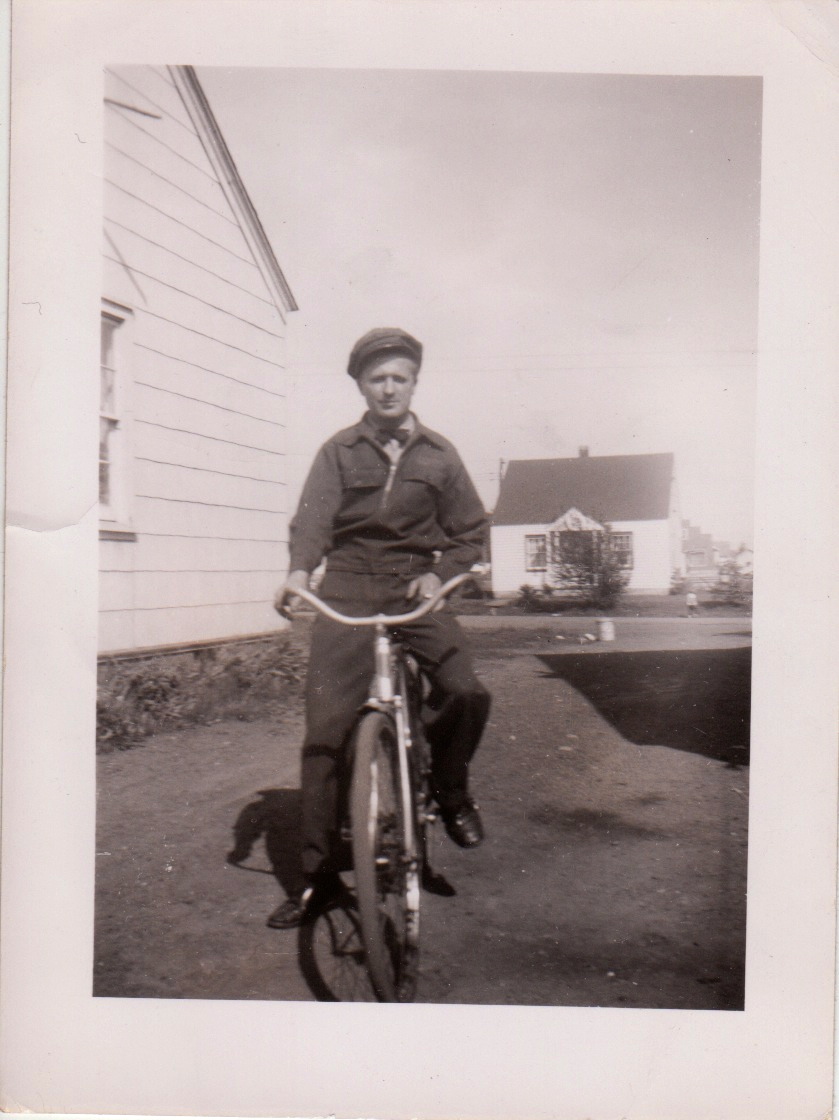
Before there were bread trucks with doors that swung open wide, that smelled of yeast, sugar and sweat, there were bread wagons.  Horse-drawn relics.  The Old Man drove one of these up until around 1960.  His horse’s name was Tootsie. Toots. She was brown and hard working. I don’t actually remember her as a real living creature.  I see photos of me next to the wagon but I don’t recall the time, the experience.  My Old Man was the last Breadman to use a horse-drawn wagon.  There was an article about him in the local paper years later that said he was the “last of his kind.”  They got that right.

There’s just something about a man who drives a wagon full of fresh baked bread and doughy treats, pulled by a horse named Tootsie, that draws people in.  He was like the Pied Piper.  Kids couldn’t get enough him and his wares.  And his appearance in the neighborhood was quite possibly the highlight of some exhausted housewife’s day.  Possibly they flirted.  At the very least they exchanged pleasantries. It was nice.

I must confess I had mixed feelings about The Old Man’s occupation.  On the one hand I was grateful that he worked every day and provided for his family. However meager it may have been at times.  But there were many occasions when I was ashamed or embarrassed.  Especially when someone asked me what my father did, and in particular if the person asking had a father who wore a silk suit to work, and not a blue twill uniform that smelled of bread dust and sweat.  Then, I didn’t want to admit that I was the Breadman’s daughter.  I wanted him to own the company, not deliver the bread door to door.  But in the safety of my own neighborhood, where everyone’s dad had a crappy job I didn’t care.  In fact, I loved that he had a job that attracted people like bees to honey.  But outside of Kenogami Avenue, things were different.  And the older I got, the more painfully aware I grew of the differences between the neighborhoods.  The white vs the blue.

Even now, years later and thousands of miles away, when someone with a white collar demeanor innocently asks me what it was that my father did for a living, a part of me hesitates.  Cringes.  Blushes with embarrassment. Be it ever so brief, it’s there.  The automatic response to a memory imbedded in my DNA.

What did my father do?  He served. The Shaw Bread Company. His loyal customers. A brown mare named Tootsie. He did it all with good humor.  Silly jokes.  Kindness and generosity.  And according to the article about him, he did it quite well.  The most important thing I learned about working, my father taught me on those sunny summer afternoons when we barreled down the hills on our way to the lake.  Or on cold winter nights when we tore open white envelopes addressed with cheerful Merry Christmas greetings and chocolate boxes wrapped in green tissue paper.  Not by his words.  But by his actions. Yes, this is what the last of his kind taught me.  To serve.

And I am The Breadman’s daughter.

The Old Man at work 2

The Old Ma on his bike

Diaries of the Breadman’s Daughter: Life is a Beach.

Ma always on the lookout at Sibley Park.

I can’t swim.  But I do like the water – to an extent. If my body were a map, my breast bone would be the dividing line.  Like the equator.  That’s the border between fear and faith.  It’s the big divide where comfort zone meets terror.  But I do love the beach and pretty much everything about it.

Little back story.  I came by my fear of the water honestly.  Ma passed it onto me along with a fear of driving, dark streets at night, wild animals and dirty underwear.  I’m not sure of the origin of Ma’s fears.  Certainly not her own mother, since she died when Ma was three.  Regardless, Ma was not a big fan of aqueous immersions.

The way Ma expressed this fear was both lamentable and exasperating. It went something like this. It’s a beautiful sunny day.  We’re at a beach.  One of three – Chippewa Park, Boulevard Lake or Sibley Park.  Each had noteworthy characteristics that I loved.  Chippewa had an amusement park of sorts (merry-go-round) and a zoo (polar bears in dirty cement pits) and a long shallow seductive shore.  Boulevard was in town, easy to get to by bus, had a great concession booth and comfortable grassy shoreline.  Sibley was an hours drive from town, was situated on the Sleeping Giant (which in itself was irresistible enough), had a hot sandy beach and freezing cold water (which made me giggle and shiver upon initial entry.)

As this story unfolds, we are now at the beach. I’m in my bathing suit, Ma’s in her capris and The Old Man is jauntily attired in slacks and a short sleeved cotton shirt.  Usually I have at least one friend with me.  Most often it is D from across the street.  She’s one of five C-kids and I am a devotee of this wonderful crazy mixed up dysfunctional family.  We’re all appropriately attired, a blanket is laid out on the sand, towels and flip flops are tossed carelessly about and delicious snacks that Ma has packed are set out carefully on the blanket.  (If we’re at Sibley Park a picnic lunch will also be included in the day’s fare.)  D and I head down to the water and everything is copacetic.  Except it isn’t.  Already I feel Ma’s tension.  It permeates from her body like a noxious over-powering perfume. Just as our toes touch the water’s edge I hear her calling.  “Not too deep now!” she cries.  “No further than your knees.”  Knees?  Are you kidding?  So I call back, “Ma, you can’t swim in knee-deep water!”  “Okay, then no deeper than your waist,” she replies.  Waist?  Really?  So D and I wade out to where waist meets water.  And Ma hollers, “Far enough!”  Are you kidding?  Apparently not.

Compliantly, D and I find our little piece of liquid splendor somewhere between knee deep and waist high.  And we frolic.  And splash.  And squeal.  We dog paddle.  And float on our backs.  We blow bubbles with our faces under water.  The entire time, Ma’s worried anxious eyes are upon us.  I can feel her held breath.  Her pounding heart.  But she doesn’t say a word. She doesn’t have to.  Except when she thinks we’ve strayed too deep.  Or for that one millisecond when she loses sight.  We’ve drifted behind the fat kid floating in the ten-foot tractor tube.  And we’re gone.  Ma calls my name.  I can hear the edge of hysteria in her voice.  I emerge from behind the tractor tube boy.  Safe.  I wave reassuringly.  And all is well.

As a result of all that fretful smothering by the shore, I never really learned how to swim.  I spent much of my time reassuring Ma that I was indeed alive and still breathing.  But also, another thing happened.  I grew fearful too.  Maybe it was dangerous.  After all, we heard those tragic stories of kids who drowned, leaving in their wake broken-hearted devastated  parents.  Not just in lakes either.  But in creeks.  And bathtubs.  Mud puddles even.  Water was a heinous loathsome devourer of little children.

Of course, deep inside the well of Ma’s fear of water was just the plain and simple fear of loss itself.  Her losses were so great.  And they came so early.  I don’t blame her for wanting to hang on and protect those who were most dear to her.  To somehow hold safe, the small.  And the fragile.  The vulnerable.  Prevent them from walking into the deep.  And never return.

I don’t recall Ma ever going into the water.  Even her bath water was shallow.  I do have one lovely ancient black and white photo of her in a lake.  It looks like she is up to her neck but apparently as the family story goes, that was all trickery.  The water was no deeper than her waist.  Still the end result was one beautiful photo.  Of one beautiful, frightened courageous woman.

All this fear and anxiety aside, I still have only the fondest memories of summers growing up.  Despite her fears, she faithfully took me and my friends to the beach.  And through the years, I learned that there are many things to do by the water’s edge that are equally entertaining as swimming.  Adventures to be sought.  Imagination to be awakened.  Treasures to be hunted.  Oh the natural beauty of polished pieces of glass.  The Noxzema blue bits were my favorites.  Broken shells and hunks of gnarly driftwood.  Exotic micro creatures hiding under rocks.  Sand castles and suburban homes.  Catching miniature fish in yellow plastic pails.  The tickle of hot sand as it sifts through your toes.  The music of waves rushing to shore. The sounds of laughter and glee.  The smell of Coppertone.  And hot dogs.  French fries and onion rings.  And the glorious sun high in the large blue sky roasting our skin and filling our hearts with warmth.  And the promise of forever.  These were the gifts that Ma provided. This was the trade-off.

Magic.  And mystery.  And wonder.  All this in place of the butterfly kick and the front crawl.   But I have learned to swim in other ways.  I know the fine art of survival.  And the dance of intent.  The call of the courageous.    I know when to hold up my head and squint into the sunlight.

I wrote a song called Sibley Park.  It was inspired by my summers spent there with Ma.  Here are the lyrics.  It’s in the key of C.  Like much of my life.

Sibley Park © by boo king

We went to Sibley Park
And we swam in the coldest part
We took pictures of the three of us
Just you and me and Gus

The sand was beige and hot
And my suit was full of polka dots
We took pictures of the three of us
Just you and me and Gus

We ate Oh Henry bars
And you dove off my freckled arms
We took pictures of the three of us
Just you and me and Gus

Our moms sat in the shade
As we swam and they drank lemonade
They took pictures of the three of us
Just you and me and Gus

Gus barked and chased a stick
As he raced and he   did dog tricks
We took pictures of the three of us
Just you and me and Gus

I went to Sibley Park
Where we swam in the coldest part
I kept pictures of the three of us
Just you and me and Gus

I wonder where you are
You recall the way we were before
When we took pictures of the three of us
Just you and me and Gus.

Diaries of the Breadman’s Daughter: The Fine Art of Courage and Sunflowers.

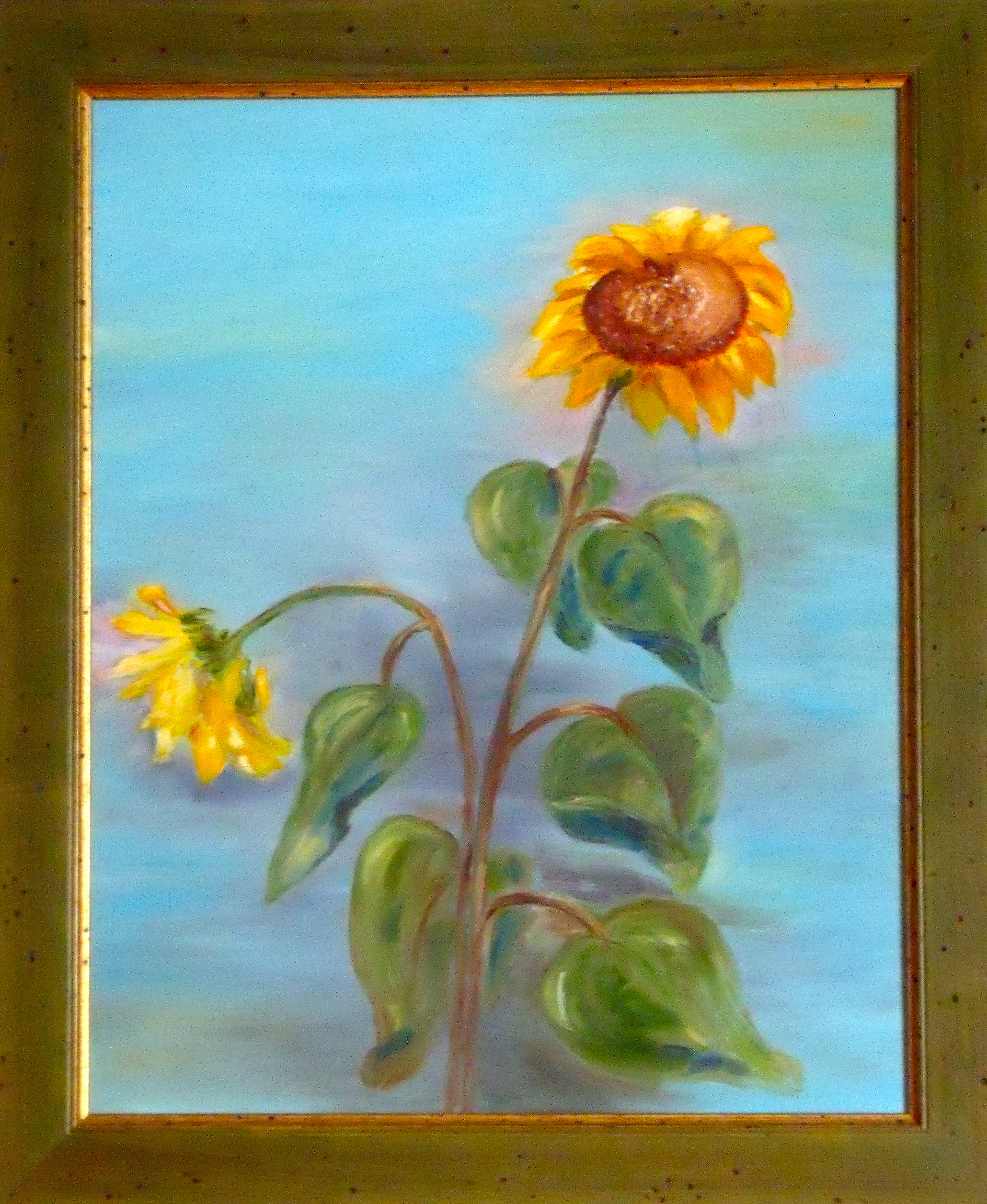
Ma’s Sunflower painting wide and open.

I love sunflowers.  They are such a cheerful good natured flower.  If they were people they would be the kind with the wide open faces and big toothy grins.  You know the sort.  The ones who always see the sunny side of things. The good. The optimistic. The hopeful.

Little back story: My love affair with this blithe bloom actually began as a seed.  As much as I loved the flowers, it was nothing compared to my love for the seeds.  Not the healthy versions that you buy in health food stores or in the bulk food section at the grocery store.  I’m talking about the ones you buy in the chip aisle or at your neighborhood corner store, the depository for all things so good tasting yet so bad for you.  I’m talking the super salty variety in their shell.  The ones that you suck, crack open, chew, swallow, wash down with soda.  One bag of Giants and your mouth is begging for mercy.  This is my idea of the perfect sunflower seed.

One summer The Old Man and I planted sunflowers all around the perimeter of our back yard.  They grew tall.  And confident.  And winsome.  They were magnificent.  I loved them.  The Old Man Loved them.  Ma loved them. The birds especially loved them.  Everyone was happier that summer.  Sunflowers have a knack for bringing out the best in all.  Perhaps that explains their popularity.

Ma wasn’t a gardener.  She left that to The Old Man and me.  Ma was an artist. I didn’t really appreciate her artistic abilities until she turned sixty.  Not that Ma suddenly became Picasso or even Grandma Moses on her sixtieth birthday, and then we all took note.  It’s more that Ma’s creative talents weren’t so clearly defined, at least not to me.  An “Artist” by my limited definition, was someone, most likely bohemian in nature, who had abstract paintings in uptown galleries, SoHo cafes, coffee table books or at the very least was someone like the quirky art teacher in my high school.  Not my mother.  But her domestic talent was always present, manifested in everything she touched.  From the one-of-a-kind clothes she sewed for me to her scrumptious baking and homemade pasta and bread.  Everything she made with her expressive hands was a work of art.  A masterpiece.

At sixty Ma went back to high school.  At night.  To study art.  Oil and charcoal.  I can only imagine the bravery it took to embark on such an endeavor.  What a personal challenge it must have been.  But also what an adventure.  What a magnificent obsession she must have had.  I say this because she was so painfully shy and timid.  Her voice, at times was barely audible.  You had to really listen to Ma when she spoke or you would miss all the good stuff.  The wisdom. The gems. The humor.

Off she went. Courage mustered. Heart full.  Audacity emblazoned. Once a week she headed out to my old school where she studied fine art.  Drawing and painting.  Life and landscape.  People and places.  Her imagination was set free.  She was firing on all cylinders and having the time of her life.  She was in bliss.  Cloud Nine.  Heaven.  And yes, it was oh so fine.

Ma’s life as an artist could have started much earlier than age sixty.  Raising a family, time commitments, financial struggles, shyness and fear aside, there was something far more sinister holding Ma back.  She told me a story once that both broke my heart and made me angry.  When she was a young girl in grade school she drew a picture.  I think it was of a cat.  Proud of her drawing, she showed it to her teacher.  Instead of praise and encouragement she was met with accusation and shame.  The teacher accused her of tracing the cat, berated her, saying that she couldn’t possibly have drawn it so accurately without having cheated.  Needless to say, this crushed Ma.  Her spirit.  Her talent.  From that moment onward she kept her artistic dreams a secret.  Locked away inside her precious little-girl heart for decades.

I have no idea what the catalyst was for her change of heart, for the unearthing of her secret desire.  I don’t know what made her push the fear and shame aside in favor of following her dream.  It seems that one day she just did it, as if out of the clear blue.  She had a notion and acted on it.  And I’m so glad she did.

Ma had many many joyful years of painting.  In particular, she liked to paint flowers. I remember towards the end of her life, when she was in her late seventies, I asked her to paint me some sunflowers.  By then, she had pretty much abandoned her easel, canvases and paints.  She simply stopped.  Almost as quickly as she started. For no apparent reason. Another notion perhaps.  Again I had no understanding of why.  It was all a mystery to me.  The enigma of Ma.  The request for the sunflower painting was my vain attempt to coax her back into doing the one thing in life that brought her such joy, that had nothing to do with raising kids or managing a home, taking care of The Old Man.  It was just Ma’s.  Uniquely hers.  I also really wanted a painting of sunflowers for my living room wall.  But she kept putting it off.  Said she’d “get round to it one of these days.”  Then I dropped the subject.  She was getting old.  Then she had the heart attack.  And everything changed.

After Ma’s funeral, on a cold February night in a small town in Northwestern Ontario my siblings and I visited the home where we all grew up.  This would be the last time I would ever step inside this place.  It was cold outside but even colder inside.  It struck me that without Ma, there was no warmth.  This was now just a small wartime house in the west end of nowhere.  I visited each room for one last time, collecting little mementoes and treasures that once belonged to Ma.  My siblings did the same.

Upstairs in the room that was once occupied by my older brothers, then by me, and was one of the places where Ma liked to paint, I found the most resplendent keepsake of all.  The sunflower painting.  There it was.  Waiting for me.  Even after she had moved on, she was still giving me gifts.  Suddenly the room grew warmer.  My heart was light.  My face open and wide.  My grin big and toothy.

Diaries of The Breadman’s Daughter: Not a Dream House But a House to Dream In.

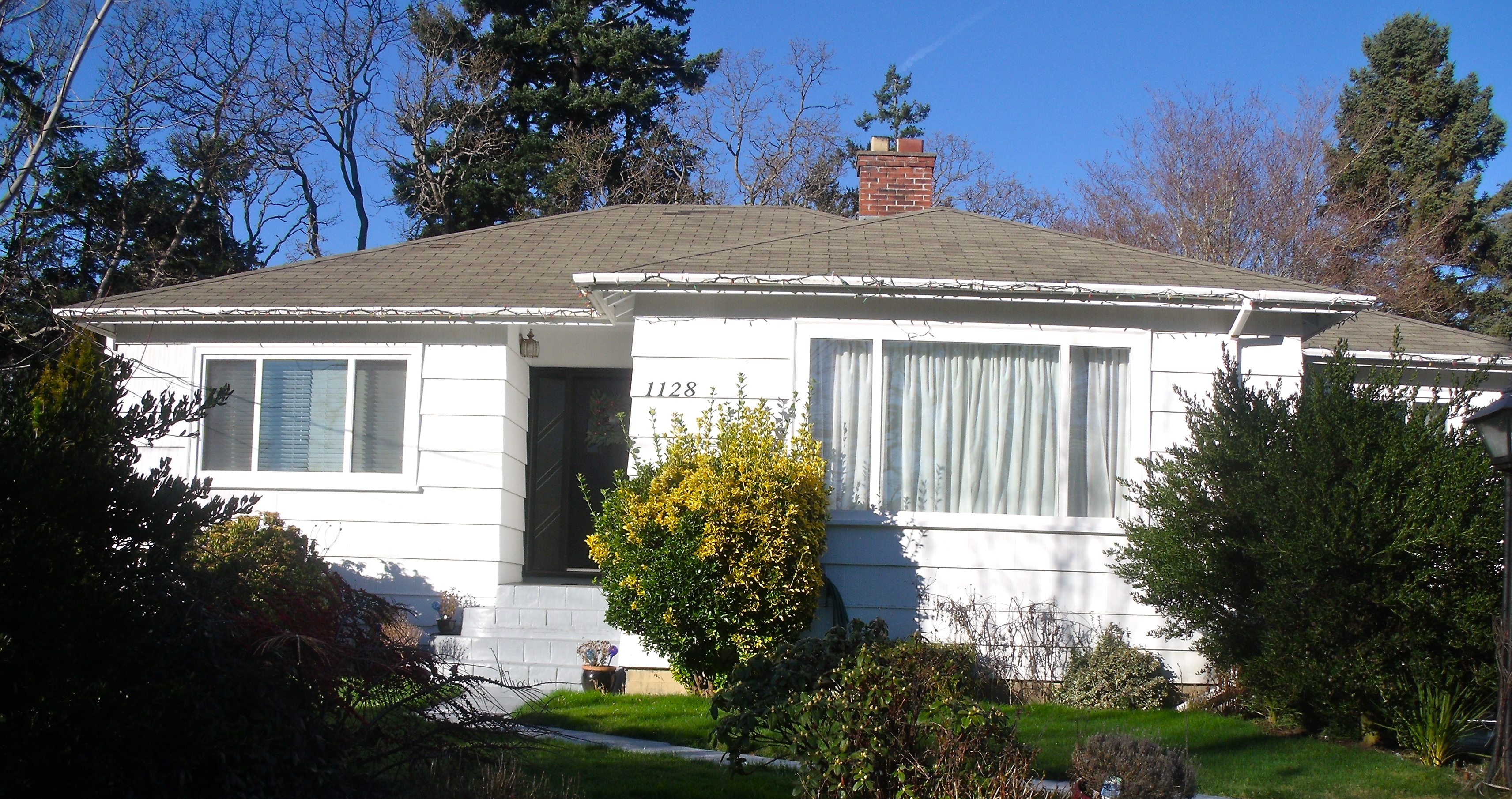
The little white house around the corner.

I own a home.  Truthfully, I own it with my husband and the bank.  For the most part I don’t think about the bank partnership, except for when it comes time to renew our mortgage.  I had dreamed of owning a place on the West Coast long before it became a reality.  You might say that the day we were handed the keys to the front door was a dream come true.

Little back story.  Both my husband and I had owned homes in previous lifetimes, with our former mates.  When I was five months pregnant with my oldest daughter, my ex-husband and I bought a house.  It was brand spanking new and nestled smack dab in the middle of a cul-de-sac in an equally new suburb within walking distance of the house where I grew up. I use the term “suburb” loosely here because I’m talking about a town, not some sprawling city.  There really weren’t suburbs, just neighborhoods added to neighborhoods added to more neighborhoods until some were almost on their way out of town, like this one happened to be.  And to be honest it didn’t take much to be within walking distance of anywhere in my hometown.  For two very good reasons.  Firstly, it was considered small – not rural small but definitely on the shy side of a real bonafide city –  so walking anywhere was within distance.  Secondly, I have always had a love affair with walking, and can go the distance, at least within reason.  A trek across the country would be considered unreasonable in most people’s books, although some have ventured forth.  But that is not my idea of a good time so it won’t be happening any time soon.

That ever so brief foray into home ownership was embarked upon more for practical reason than anything else.  Nothing dreamy.  More nightmarish.  I was pregnant, full of baby hormones and hellbent on having a proper home in which to bring my new offspring.  We had been renting a small apartment (by anyone’s measurements) that was barely big enough for the family we already had.  This consisted of my ex-husband, my son and an intelligent black Persian cat named Isadora, who used to pee in the toilet, which is more than I could say about my son at the time. In his defense, he was young and I’m still prone to exaggerate the length of his potty training stage.  In my defense, I think for most young parents this chapter in childhood development feels like an eternity.  But I digress.  What’s important here, is that in my mind it was essential that we find a bigger abode.  Back then home ownership was still within everyone’s grasp.  So we saved four months worth of my wages, slapped down a downpayment and moved in.  A year later we moved to Toronto.  End of back story.

Up until 10 years ago my current husband and I were renters. (This is beginning to sound like I’ve had a string of husbands and habitations. I haven’t.  Just for the record.)  The thing about renting is it costs a lot, sometimes more than a monthly mortgage payment.  And a roof over your head aside, it does nothing for your bottom line.  We never had enough left over at the end of each month to save for a downstroke on a house.  Not that we lived beyond our means, but we did use up every bit of what was left after we paid the rent.  Then Ma died and five weeks later the Old Man followed her into the Great Hereafter.  And then a year later a miracle happened.  With a small inheritance in hand we marched to the bank and proudly declared “one mortgage please.”  It didn’t go down exactly that way, but you get the picture.

Once the mortgage amount was determined, we then knew the price range of the house we could actually purchase.  We met with a Real Estate Agent on a Friday night, chose a selection of places within our price range, and mapped out a plan for the following Sunday to “view houses.” Imagine that.  We were now people who viewed houses.  How exciting.

The next day something very serendipitous happened.  We were on our way to the grocery store when we noticed a “For Sale” sign on a house just around the corner from where we lived.  It was a cute little white house, a forty’s postwar ranch style thingamajig.  There was something familiar about it that spoke to me.  Close proximity to where we lived aside, until I saw that “For Sale” sign I hadn’t even noticed it before.  Not sure why.  Perhaps because it was so unassuming and modest that it just blended in.  We called our Real Estate Agent and asked her to add a house to the list for “viewing” the next day.

The little white house around the corner was the first house we saw.  I walked through the front door and I was home.  There it was.  No need to look any further.  After 25 years I had come home.  It was sweet.  And simple.  And dear.  Unpretentious and humble.  Full of natural light.   Round corners and wooden floors. Families had lived there. Loved there.  Prayed over evening meals and sick children, dying dogs, birds that flew the nest.  It reminded me of the house I grew up in with Ma, The Old Man and my three siblings.  It spoke to me.  This was the house I wanted to buy.  We looked at a half-dozen other places that day but it was all just a formality, the new homebuyer jig to appease the Real Estate Agent and her desire to have done her due diligence. We respected that.  But at the end of the day I declared, “Let’s put in an offer on the first house we saw, the little white house around the corner.  I liked that house.”

This little house that I live in and own with my husband and the bank wasn’t my dream home. Far from it.  This little house was not the picture I tore out of magazines and kept in scrapbooks, nor pointed at while walking with Ma, nor envied while visiting others with homes in the style that I fancied, nor was it the centerpiece of my domicile daydreams.  No, this little white house around the corner was not my dream home.  But it was something far better. It was my home to dream in.  And after ten years, I know without a doubt that it is more than I could have ever imagined.

Diaries of the Breadman’s Daughter: Every Girl Needs A Room Where She Can Dream

The Dreamer.

I have a room of my own.  Virginia Woolf would applaud this I’m sure. I’ve been blessed much of my adult life to have had such a space, a little sanctuary to call my own.  In this room, I get to be me.  Or at least the me, I imagine myself to be.  I’m a self-proclaimed dreamer.

Little back story.  Growing up I shared a bedroom with my older sister.  Not only did we share a room but much of the time we shared the same bed.  A double, which slept two rather comfortably.  Sometimes we were strange bedfellows but mostly we were amiable, considering our 8-year age difference.  The room we shared was downstairs next to our parents.  My two older brothers occupied one of the two upstairs bedrooms. The other room was our “spare” which was cold in winter but a fun place to play, and hang out with Ma while she sewed. By the time my sister moved to the West Coast and my two older brothers were both married, I had moved upstairs to their old room.  I finally had a room of my own. It was divine.

There were four things I especially liked about this room.  The slanted ceilings, the small attic door next to the closet, the brick chimney next to the door, and the wooden vent on the floor that you could peer down and see into the living room. There was something enthralling about these four details that captured my imagination.  I loved to poke around in the attic which was dark and musty and contained the usual things like Christmas ornaments, dance costumes, childhood artwork, old toys and a broken lamp or two.  But what was most beguiling was the possibility that buried deep within all this family memorabilia and junk was some mis-placed and forgotten treasure.  The vent was both scary and practical.  Scary because there was the possibility (although slim) of falling through it and practical because I could drop little notes down to Ma while she was sitting on the couch watching Ed Sullivan. I don’t recall what these messages to Ma said but most likely they were requests for food or drink.

Ma always made our home look lovely.  She didn’t have much to work with financially but what she lacked in cash, she made up for in imagination.  She just had a knack for this sort of thing and like most women of her time took care of “the decorating.”  I use this term loosely because no one spoke that way back then, at least not regular folks like Ma and The Old Man.  Decorating meant Ma made things for the house – curtains, table cloths, pillows.  She sewed and embroidered.  The furniture and appliances were bought on time at Sears or Eaton’s.  We weren’t poor but we were also a few miles from the middle of middle class.  Everyone in our neighborhood was, so it didn’t really matter.  At least not to me.

When it came to my room, Ma graciously handed over the decorating torch and without any strings attached either.  I was given free rein to do whatever my heart desired.  So I did.  I plastered the walls with rock posters and my kitschy-coo personal art.  The Old Man painted the chimney white which became the perfect blank canvas for my poetry, lyrics from folk musicians like Dylan and Leonard Cohen, pithy quotes by the pop psychologists of the day.  “If you love something set it free.  If it comes back, it yours.  If it doesn’t, it never was.”  I somehow found this to have deep meaning back then.  It just baffles me now.  Somehow we came into possession of an over-stuffed antique maroon velvet tub chair that had worn arms and smelled bad.  We put this in the corner for me to curl up in and read.  I had a desk that overlooked our driveway and stared directly into our neighbors upstairs window.  Thankfully they kept their curtains closed allowing us both the privacy we needed and me with the added blessing of natural light. I also had a record player, and by then a fairly decent collection of LPs which I played continuously.  Everything from The Beatles and the Rolling Stones to Dylan and Joan Baez.  From Rock to Folk, Motown to Blue Eyed Soul. This music comprised the soundtrack of my life.  It was the fire beneath my dreams and it fueled my creative passion.

It was in this little room at the top of a wartime house in the middle of small blue collar town where my dreaming wanderlust began.  I read books and dreamed of becoming a novelist.  I played rock music and dreamed of becoming a musician.  I made my own clothes and dreamed of becoming a fashion designer.  I scribbled poems on brick chimneys and dreamed of becoming a poet. I danced in my pajamas and dreamed of becoming a ballerina.  I doodled on albums and dreamed of becoming an artist. I gazed out at the stars and dreamed of flying.  I cuddled a dog named Sugar Miettinen and dreamed of becoming a mother. I had a typewriter and dreamed of using words to transform lives. I looked down at the street below and dreamed of a life outside of this room and wondered how I would get there.

And here I am.  Thousands of miles and many years away.  In this room, I write novels and blogs.  Play my guitar and write songs.  I sing to myself and dance like a wild woman. I gaze out the window at a sweet little pond and a garden full of Garry Oak trees, and I am in awe.  Full of wide-eye wonder and gratitude. I’m eternally grateful to Ma and The Old Man for giving me that first room and for allowing me a place to plant the very seeds that my dreams were made of.

Here in this room, I am becoming the woman of my dreams.

Diaries of the Breadman’s Daughter: A Good Snow Day Trumps All.

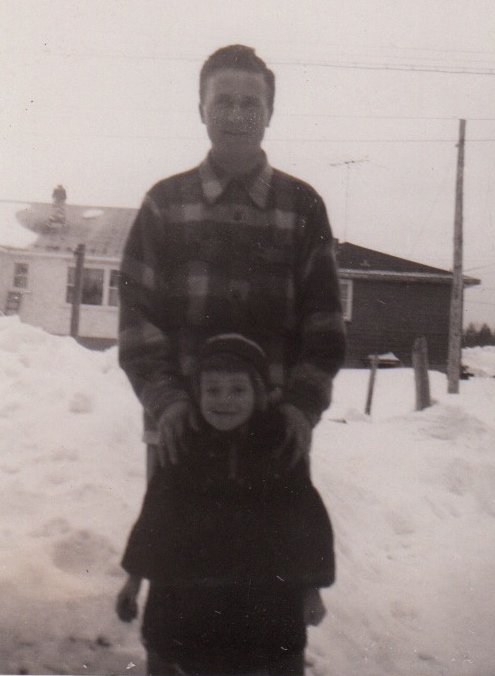
Me and The Old Man posing in the snowy backyard.

I love a good snow day.  I always have. We had one last week.  They are pretty rare in this part of the country so when one happens it’s an ‘event.’  Not momentous like Christmas, a wedding or a milestone birthday.  But in some nonsensical way, celebratory just the same.  And if the truth be told, the amount of snow that causes a snow day on the West Coast is laughable compared to that of my wonder years.  A heavy enough frost out here can bring the city to its collective knees.  The size of the celebration is not necessarily equal to the depth of the snow either.  It’s not always relative.  I think even Einstein would agree.

When I was a kid a snow day was synonymous with no school.  That in itself was cause enough for celebration.  Nothing much has changed since then.  When my kids were younger they behaved pretty much the same way I did. Their reactions echoed those of a girl growing up in another place, another time.  Same holds true today for my grand daughter.

It pretty much goes down like this.  If you wake up to a magical and mysterious Brobdingnagian sized nighttime dump, you immediately turn to some form of authority for their take on the situation.  I’m not talking about your parents here.  I’m talking the BIG authority.  And no not God.  I’m talking the Media.  And only the local, close-to-home purveyors of news and weather will do.  Who cares what’s going on in the rest of the world when you’ve got a day full of plans to make, your life to reconfigure.  Your snow day trumps all.  Will you do the happy dance, jump for joy, slap the high five?  Or will you grit your teeth, throw on an extra sweater, button up your pioneer spirit and walk five million miles to school in this crap?  One’s emotional landscape can be turned on a dime depending on the news.  Pretty or ugly.  Which is it?  Truth is, it’s just cold precipitation and sometimes it can be pretty ugly.

Let’s say the news is cause for celebration, a paradoxical thing often occurs, whether it happened last week, last year or the last century.  The very same kids who are incapable of pulling up their bootstraps (literally) and getting themselves to school are supernaturally transformed into hardy Nordic tribesmen who charge fearlessly into the very depths of the white stuff.  Here they commune, they romp about, and play gleefully like there is no tomorrow.  And in truth there isn’t, at least not like this.  This may be it.  The one and only snow day.  The one chance to throw caution to the wind, make a snowman who bears an uncanny resemblance to Uncle Bob, fall backwards, with complete trust into the blanketed earth, to make a glorious one-of-a-kind snow angel, slide down the closest hill on a rickety wooden sleigh, broken toboggan or hunk of cardboard, have a spontaneous snowball fight, put on old leather skates, cry out to God for the sheer splendor of it all, and just let go.

Snow is seductive.  It beckons.  Calls your name.  Calls you forth.  And calls you back home. It calls a treasured daughter to a garden-sized ice rink her Old Man made in the backyard solely for her skating pleasure.  It calls out love through the years, the passage of time, from the heart of the whiteness.

Diaries of the Breadman’s Daughter: Regrets, Do-overs and the Night My Dog Died.

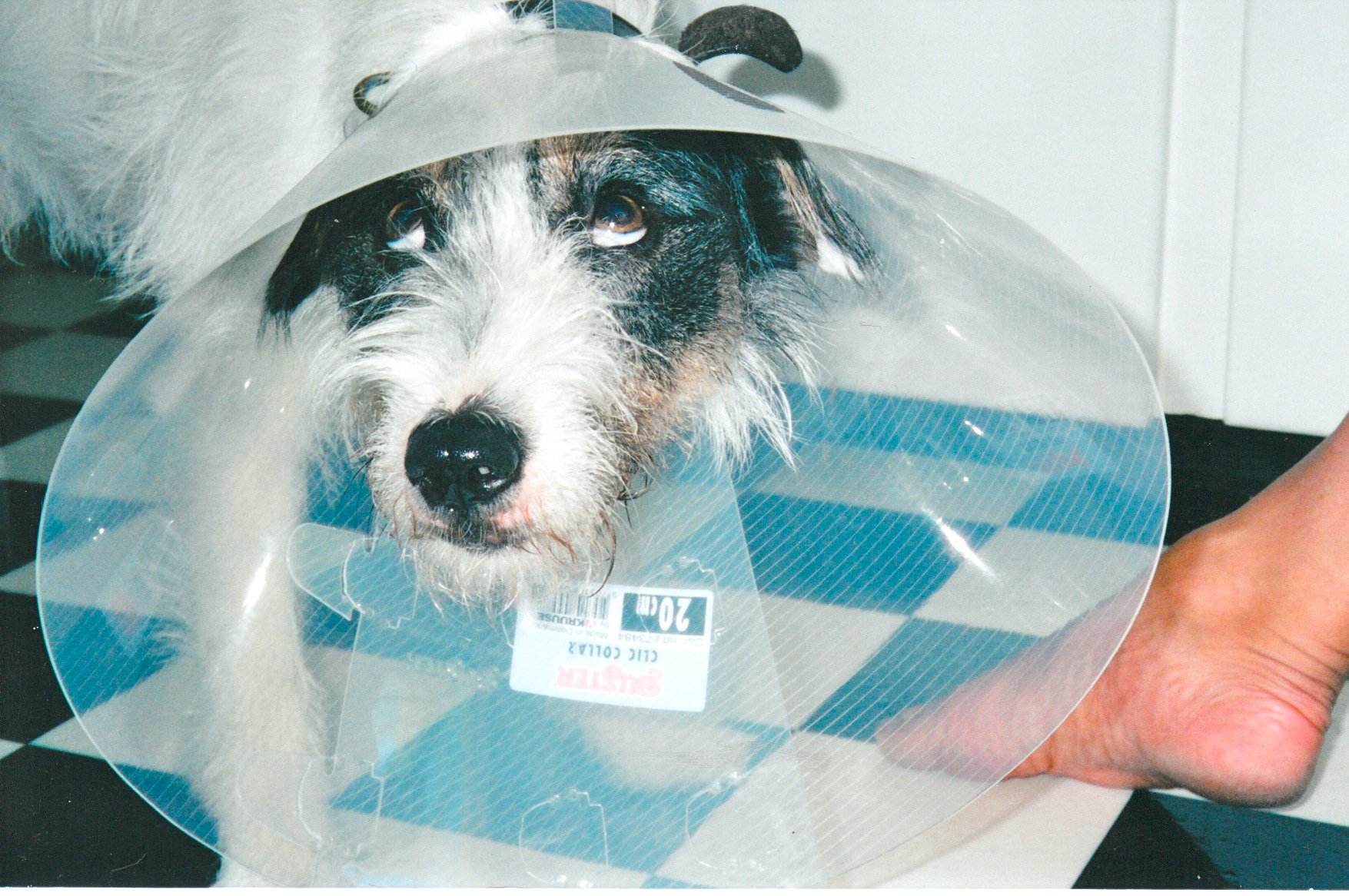
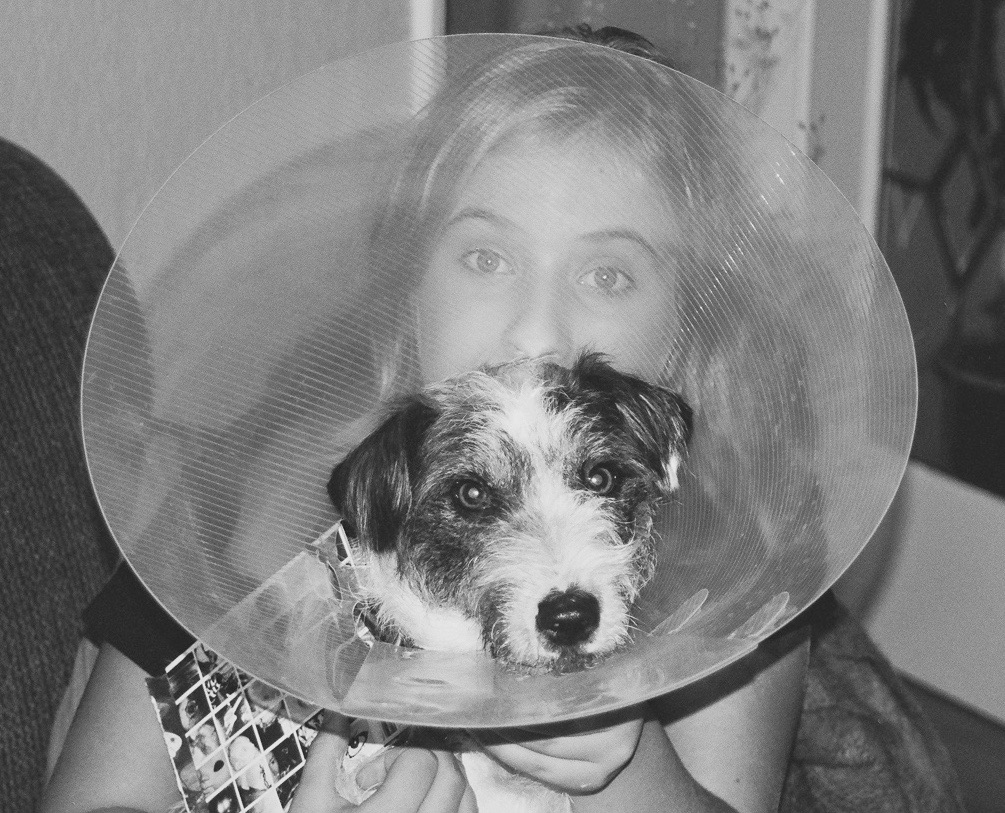
Andy hated having to wear the dreaded “cone.”

I have regrets.  Probably more than I care to admit, or face.  I’m not one of those people who boldly declare, “I regret nothing.”  I don’t necessarily wallow in them like a drunk on the bar stool, but they do exist and suffice to say, are now part of my DNA.  I don’t judge but I do acknowledge.

One of my biggest regrets, and the author of my sadness, is that I wasn’t with my mother when she died.  I was there a few hours beforehand but not at the moment she left.  That was over a decade ago and I pined for a do-over, an opportunity to hold her hand, say one last good-bye and bear witness to her presence and her passing.  And until last September I thought this was just the wishful thinking of a heartbroken daughter.  But in a peculiar and unexpected way I got my do-over.

Little back story:  On those rare occasions when Ma went to her Dark Place she would refer to herself as a dog.  “I feel like a dog,” she’d say.  Ma wasn’t one to feel sorry for herself, but we all go there at times and she was no exception.  Although I heard her sorrowful dog Mantra and even took it to heart at times, I also dismissed it as crazy-talk, and never really gave it much energy nor validation.

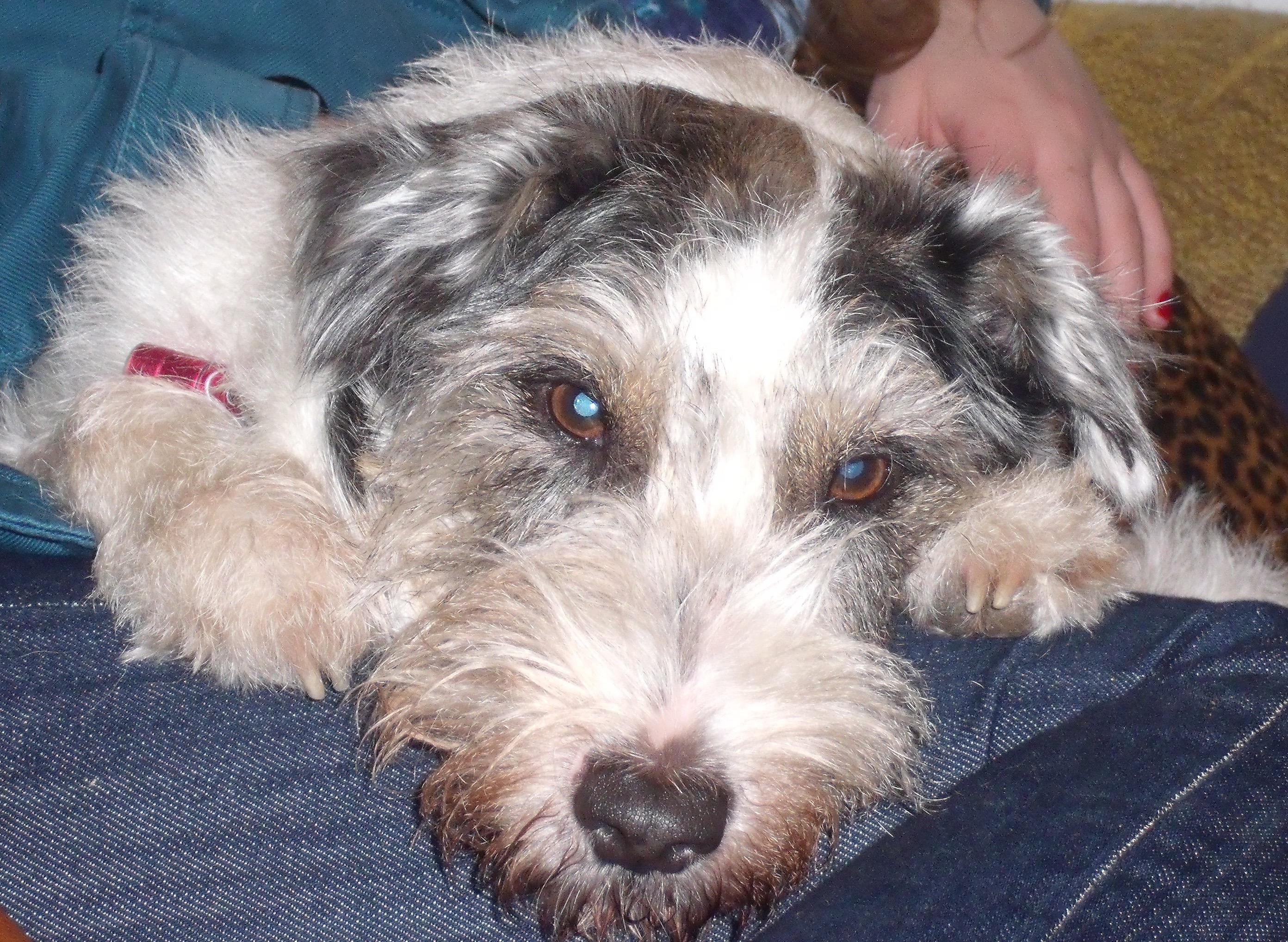
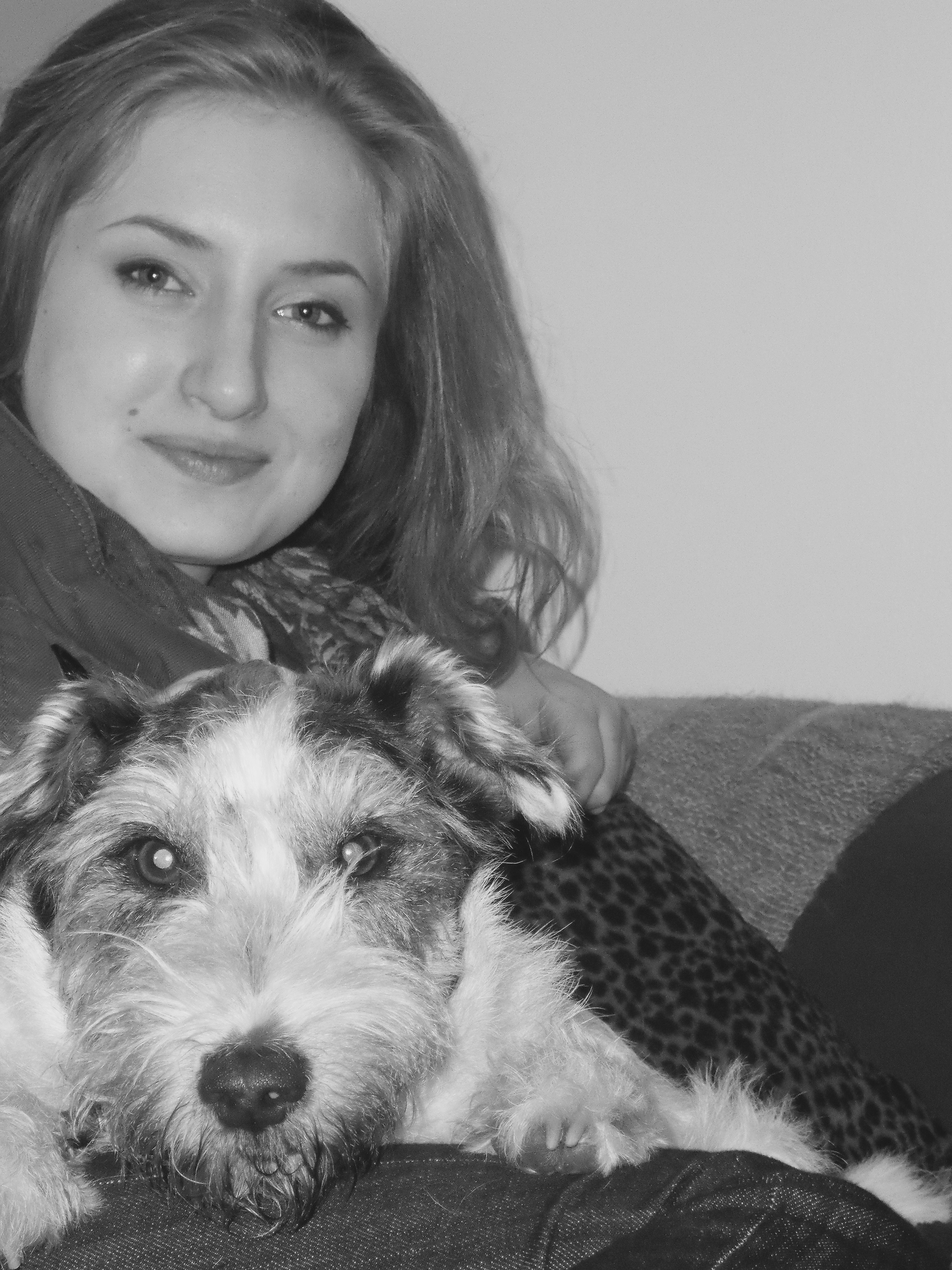
Then I fell in love.  At first sight.  With Andy.  He was a dog.  Really.  Literally.  A long haired Jack Russell. Not since the dog of my childhood, Sugar Miettinen, had I loved a creature so.  He was heavenly.  Divine.  A wonder.  And I loved him. We got him the year after Ma died.  We responded to an ad in our little neighborhood weekly that said something like “male Jack Russell, 12 weeks old, last one of the litter.”  By the time my husband, daughter and I arrived at the farm where he had spent his first weeks of life, we had him named and our hearts were spilling over with dreams.  On the way home, I happily joked that it wouldn’t have mattered how much he cost, because I knew the minute I laid eyes on him, he was coming home with me.

Our daughter was nine at the time.  Years before, we had promised her that when we bought a house we would get her a puppy.  We were diehard renters and had cats because for some reason they were more “landlord-friendly,” which is, among other things, a testimony to the intelligence and cunning of the feline persuasion.  When Ma and The Old Man died, I inherited a small amount of money, enough for a down payment on our home.  A month after we moved in, so did Andy.

He took over the house and our hearts.  He was brilliant that way.  I expected him to be around for at least twenty years like Sugar Miettinen and Dee Dee, the country and western cat.  Both lived extraordinary wonderful lives.  I used to brag that my pets lived long. I had this naive notion that my love was the secret sauce, the reason for their inexplicable longevity. I was wrong.

At the beginning of September, while my husband was on the East Cost, thousands of miles away burying his father, Andy got sick.  At first I thought he had “the bloat.”  This was something I discovered on the internet after hours of research the night I noticed his stomach was swollen and he was having trouble breathing.  It was serious but not necessarily life threatening.  It was, however, enough to scare the bejesus out of my daughter and myself.  We wrapped a blanket around him and piled into my sister’s car.  I called her because I couldn’t think straight, much less drive.  My brain was consumed by “the bloat.”  By now it was well after ten o’clock so our only recourse was to take him to an emergency Vet clinic across town.  The Vet examined him, then took X-rays.  And then he delivered the news that Andy did not have “the bloat” but in fact, he had congestive heart failure.  His little heart was surrounded by water.  Mine was surrounded by pain.  The Vet, who was very nice, but due to all the surrounding circumstances, and him being the bearer of bad news, I took an instant dislike for him.  Basically he gave us two options: he could euthanize him right then or we could take him home and Andy would continue to have “episodes” and eventually he would have one final heart attack and die.  Needless to say, the floodgates opened and neither my daughter nor I could control the tears.  Not that we wanted to anyway.

I learned a couple of things about myself and my daughter in those moments after hearing Andy’s death sentence.  We don’t take bad news well, perhaps we don’t take it at all.  We’re full of hope, even when it’s clearly hopeless.  And we’re either incredibly optimistic people or we live in chasm of denial.  Regardless, just like that day nine years earlier when I knew I wasn’t leaving the farm without him, I scooped Andy up in my arms and brought him home.  I had no game plan.  I had no idea what I was doing.  I only knew that he had been sick a total of 24 hours and I couldn’t let this be the end.

Andy lasted a week.  My daughter and I tried everything we could to save him starting with a second opinion.  Two days later we took him to our own Vet and she offered us the hope we so desperately sought.  She gave us medication and prescribed a heart healthy dog food.  But by this point, Andy wasn’t interested in food and getting the pills down his throat was next to impossible.  It was tantamount to wrestling an alligator.

Thursday, September 8 was Ma’s birthday.  It was also the day Andy died.

All that day, at the back of my mind I thought “this is the day.” Ma died from congestive heart failure.  So did Andy.  Not all that unusual I suppose, perhaps a little coincidental at best, except for this.  One of the reasons I knew I would never leave the farm without Andy was because of his eyes.  They were dark and sweet like the finest rich chocolate.  When I looked into those dark sweet eyes I saw my mother’s eyes looking back at me. There was an ancient connection.  I knew him.  I shared this “knowing” with my husband and daughter.  I’m not sure they really understood but they never ever, not even once in nine years, denied my conviction that in some cosmic kooky way my mother was with me through Andy.  I always called him my “healing dog,” the one who helped ease the pain of relentless grief, and recover from the rawness of loss.

On the night Andy died I got my do-over.  I was sitting in my office waiting for my bedtime cup of milk to heat in the microwave.  It takes 220 seconds to do so.  I heard the sound of a dog’s toes tapping along the wooden floors of the hallway leading to my office.  I assumed it was our other dog Coco, who we had rescued a few years earlier from a life not worth living, coming to visit me.  Andy hadn’t been able to make the climb up the stairs for a few days so I was surprised to see him walk through the door to where I was sitting in the dark.  I greeted him, gave him a gentle pat behind the ear, told him how lovely it was to see him.  He laid down on the floor facing me.  I thought this was some sign from God that he was having a miraculous recovery and that he was healed. Hallelujah. Before the microwave could beep, Andy got up and headed towards our bedroom.  Instinctively I followed him.  He got next to the bed and started to heave and gag.  I knelt down with him, massaged his throat to help him breathe – we had been doing this all week during his episodes – and told him it would be okay.  Everything would be all right little buddy.  He let out two deep grunts, stiffened and collapsed.

That was it.  I got my do-over.  What a privilege to have been with him in his final moments, to have been the last one to touch him.  What a gift that he chose me.

I didn’t really have a game plan for how I was going to care for Andy after we left the Vet’s but I did start to think about what I would do should he die at home with just my daughter and I alone to manage on our own. I was terrified. I also knew I wanted him buried in our garden, the place where he chased sticks, laid under the Garry Oak trees, drank from the pond, sat with my husband and watched the fish, the place where he barked incessantly at every passer-by, where he stood on the rocks keeping guard over his family, the place where he pooped.  That’s where I wanted him to be.  Close.  Forever near. I knew I couldn’t dig a hole, at least not one that Andy would be placed in.  But I knew someone who could.  While my daughter held vigil, I threw on my jacket and went next door to our neighbor, who is young enough to be my son, strong from years of working as a garden designer, and who on that night, brought truth to the meaning of “good neighbor.”

In the quiet darkness, on September 8th, Christian dug a hole, and while doing so we talked in hushed tones about our mother’s deaths, about our connection to the earth, the trees and plants we both salvaged from their gardens, and most importantly, how connected we were to them. Something beyond words happened that night.  Something far greater than the death of my beloved pet.  I learned about the unwavering kindness of human beings, and their generosity and willingness to help with things that are often incomprehensibly difficult.

I am forever grateful to Christian.  He knows this.  The following evening he contacted me to see how I was.  He shared something with me, something so profound it took my breath away.  As grateful as I was to have had him participate – however unintentional on his part – in this sacred ritual, he too was grateful.  It touched him deeply.  All that day he told me he “felt so alive.”  Is this what true, unselfish acts of kindness do for us?  Even in the face of death, in the middle of the night, in the shroud of darkness, if we reach out, feel our connectedness, we get a glimpse of the Divine.

And then, we know for sure that we are alive.

DSCF4211 (1)

84910004 (1)

DSCF4234 (1)

84910005 (1)

DSCF4236 (1)

DSCF4238 (1)

84910018 (1)